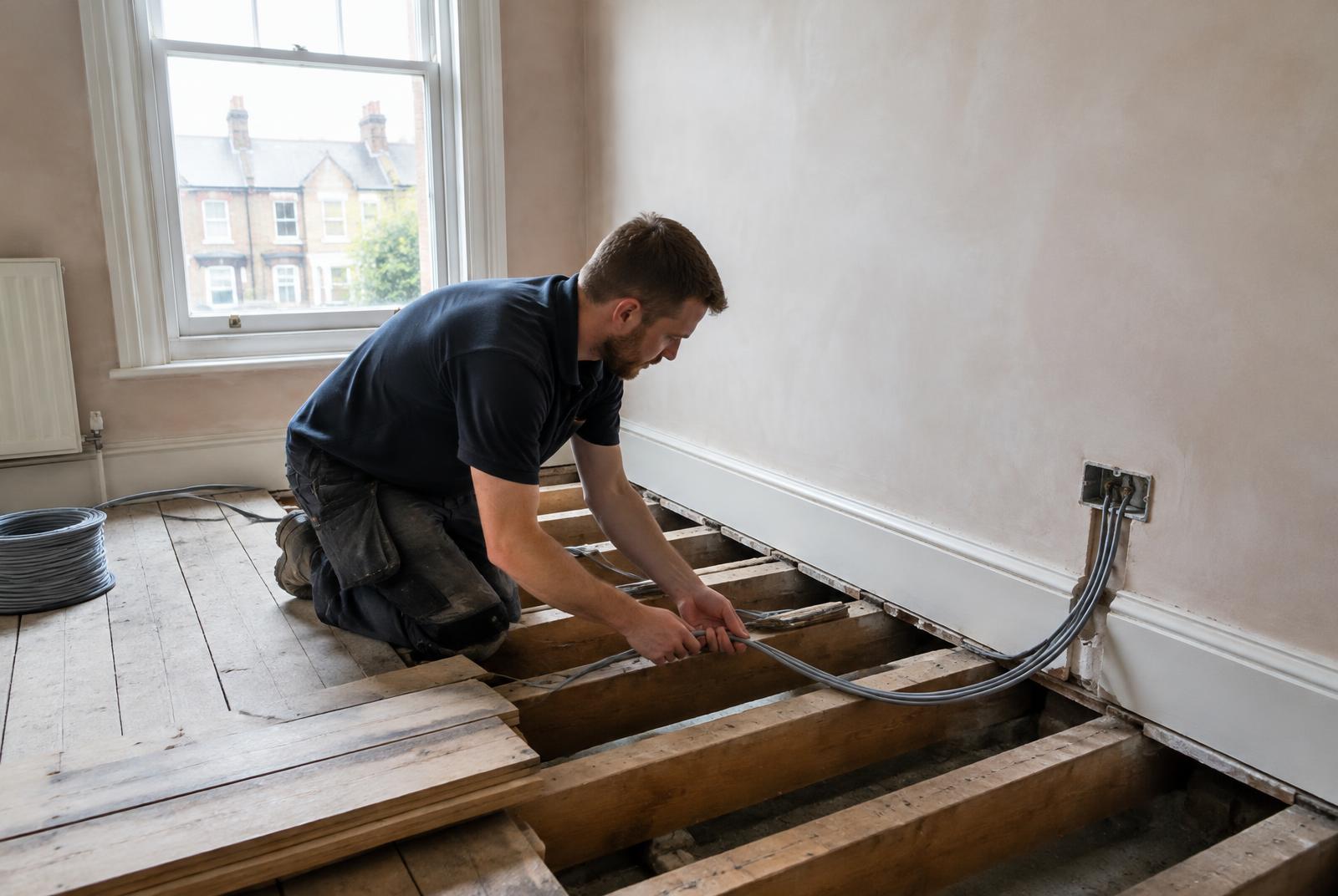
Surrey covers a lot of ground, and the housing stock reflects it. In a single week we might be lifting boards in a Victorian terrace close to a town centre, then surveying a 1930s semi on a suburban road, then working out cable routes through a 1970s detached house where the original wiring has simply reached the end of its useful life. The principles of a good domestic electrical rewire are the same in all of them; the method is not.
That's why every job starts with a proper look at the property. We want to know how the floors are built, whether there's a usable loft void, where the consumer unit can sensibly go, and how you actually live in the house — where the desk is, where the TV goes, whether the kitchen is about to be ripped out anyway.
Property rewiring in Surrey: what we tend to find
Plenty of homes in the county still run on installations that were put in decades ago and extended piecemeal since. Common findings include a mixture of cable types from different eras, lighting circuits with no protective earth, too few sockets for modern use (and the extension leads to prove it), and older fuse boards with no RCD protection.
None of those automatically means a full rewire. Sometimes a well-scoped partial rewire and a new consumer unit is the honest answer. The survey is where that decision gets made, and we'll explain our reasoning either way.
Rewiring services in Surrey
- Complete house rewiring — every circuit, the consumer unit and bonding replaced
- Partial rewiring — kitchens, extensions, single floors or individual circuits
- Rewiring surveys — find out what the installation needs before committing
- Consumer unit replacement carried out as part of rewiring work
- Socket and lighting circuit replacement
Planning the work around Surrey homes
Larger detached houses often allow most cable runs to be made through lofts and under suspended floors, which keeps chasing to a minimum. Terraces and semis with solid ground floors usually need more wall chasing and careful routing. Flats bring their own constraints around access and shared areas.
We plan socket and switch positions with you on a walk-round before first fix, so the finished house works the way you want — not simply the way it was wired in 1975.
Signs your Surrey property may need rewiring
- Old fuse box with rewireable fuses, or a board with no RCD protection
- Rubber, lead-sheathed or fabric-covered cables
- Lighting circuits with no earth conductor
- Scorch marks, warm sockets or a burning smell
- Circuits that trip regularly or lights that flicker
- Too few sockets, with extension leads everywhere
- Round-pin sockets or switches on skirting boards
- A history of DIY alterations nobody can explain
Occupied or empty: what difference it makes
Most Surrey families we rewire for stay in the house. We work in zones, keep at least some power and lighting available at the end of each day where possible, and agree in advance which rooms need clearing and when.
If the property is empty — between purchase and moving in, or mid-renovation — the job is usually quicker and cleaner, and is often the best time to do it.
What affects the cost of rewiring
There's no honest single price for rewiring a house in Surrey. The main factors are the size of the property, how many circuits and points you want, floor and wall construction, whether the house is occupied, the type of consumer unit, and how much making good is included.
- Size of the property and number of rooms
- Number of circuits, sockets and lighting points
- Floor and wall construction (timber, solid, lath and plaster)
- Loft and underfloor access
- Whether the house is occupied or empty
- Consumer unit type and any outbuildings
- Accessory finishes and specialist lighting
- How much plastering and making good is included
For more detail, see our guide: how much does it cost to rewire a house?